 English
 Arabic
 Chinese (Simplified)
 Dutch
Dutch French
 German
 Italian
 Korean
 Portuguese
 Russian
 Spanish
 Swedish
 Thai
ThaiZhejiang DeQing Community Solar-Powered Tennis Court Lighting System Case Study
I. Project Overview
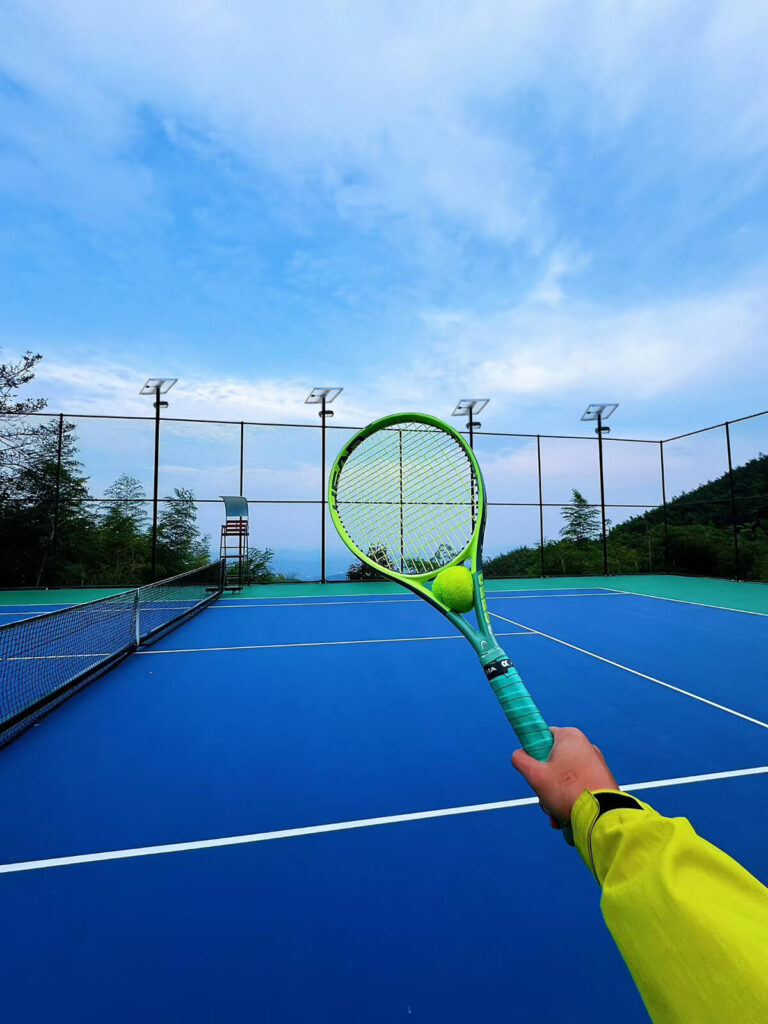
Project Name: Deqing County Moganshan Community Solar Smart Tennis Court Lighting System
Implementation Period: September – November 2024
Project Scale: 2 standard tennis courts (23.77m × 10.97m each), with spectator rest areas
Project Background: In response to the “Green and Low-Carbon Community” initiative, this project addresses the high energy consumption and light pollution issues of traditional lighting systems, while enhancing nighttime sports experiences for residents.
II. System Design Plan
1. Core Component Selection
II. System Design Plan
1. Core Component Selection
| Component Type | Technical Parameters | Selection Rationale |
| Solar Panels | 24V/300W monocrystalline (22% efficiency), 8 panels, total 2.4kW | High efficiency, suitable for rainy southern climate |
| Battery | 48V/200Ah LiFePO₄, 8 sets, total 800Ah | Long cycle life (>3000 cycles), high safety, strong temperature adaptability |
| Controller | MPPT smart controller (built-in) | 30% charging efficiency boost, overcharge/discharge protection |
| LED Lights | 300W asymmetric LED ×16, 5000K color temp, CRI ≥90 | Asymmetric light distribution, anti-glare design, 30% vertical illuminance boost |
| Light Poles | 10m height, hot-dip galvanized steel, anti-corrosion coating, 8 poles per court | Meets professional lighting height requirements |
2. System Topology
Solar Panel Array → MPPT Controller → Battery Bank → LED Lights
↑
└─ Smart Control System (Light Sensor + Timer + Remote Control)
III. Lighting Layout Plan
1. Luminaire Arrangement
Bilateral Symmetrical Layout:
- 2 poles on each side of every court, spaced 15m apart
- Poles are 4m from sideline to avoid shadow interference
- Lights mounted at 10m height, tilted 15° downward to avoid player glare
2. Optical Design Parameters
| Parameter | Design Value | Standard Requirement |
| Horizontal Illuminance | Avg. 500 lux, uniformity 0.85 | ITF Class III ≥500 lux, uniformity ≥0.7 |
| Vertical Illuminance | Serve area ≥500 lux | ITF Class III ≥300 lux |
| Glare Index (UGR) | ≤18 | Professional competition ≤19 |
| Color Rendering (CRI) | 92 | TV broadcast ≥90 |
| Color Temperature | 5000K (cool white) | 4000–5700K (enhances ball visibility) |
3. Solar System Configuration Calculation
- Daily Power Consumption: 16 × 300W × 4h = 19.2kWh
- Required Solar Power: 19.2kWh ÷ (5h × 0.85) ≈ 4.5kWp (Actual: 2.4kWp × 2 = 4.8kWp)
- Battery Capacity: 19.2kWh × 1.2 ÷ 48V ≈ 480Ah (Actual: 800Ah, supports 3 rainy days)
IV. Anti-Glare & Light Pollution Control Plan
- Luminaire Technology:
- Patented asymmetric reflector: light reflected directionally, shielding angle ≥30°
- Built-in honeycomb grille + nano-etched anti-glare glass to block side glare
- Asymmetric rectangular light distribution (120°×60°), precise court coverage, spill light <10%
- Smart Control:
- Light sensor + timer: auto-on at sunset, dimmed to 30% after 2 AM
- Zonal control: separate control for court and rest areas to reduce light pollution
V. Smart Control System Features
- Basic Functions:
- Auto light control: activates when ambient light <30 lux
- Time-based modes: “Match Mode” (100%), “Training Mode” (70%), “Maintenance Mode” (30%)
- Advanced Functions:
- Remote monitoring via mobile app for real-time status and energy data
- Fault alerts: automatic warnings for battery or luminaire issues
- Adaptive adjustment: brightness increased by 15% on rainy days
VI. Implementation Results
- Energy Efficiency:
- 70% energy savings vs. traditional 1000W metal halide lights (saves ~35,000 kWh/year)
- Annual electricity cost reduced from ¥28,000 to ¥8,000 (at ¥0.8/kWh), payback period ≈ 3.5 years
- Lighting Quality:
- Player feedback: “High balls are clearly visible, less eye fatigue during long play”
- Spectator experience: no direct glare, improved comfort
- Community impact: light pollution complaints dropped from 5/month to 0
- System Reliability:
- Protection rating: IP66 (lights), IP65 (controller), suitable for humid southern climate
- Lifespan: LED ≥50,000 hours, battery ≥10 years (LiFePO₄)
- Supports 4 consecutive rainy days with 800Ah battery backup
VII. Innovation Highlights & Lessons Learned
- Technical Innovation:
- Integrated “PV-Storage-Direct-Flexible” design: solar + battery backup, supports grid peak shaving
- BIM optical simulation: pre-construction AGi32 modeling to predict illuminance and UGR
- Implementation Insights:
- Adapted to local conditions: Zhejiang has ~1,800h annual sunshine; selected high-efficiency monocrystalline panels
- Scalable design: 30% capacity reserved for future expansion (e.g., more courts or EV chargers)
VIII. Economic Analysis
| Item | Traditional Lighting | Solar Lighting | Difference |
| Initial Investment | ~¥120,000 (2 courts) | ~¥280,000 (2 courts) | +¥160,000 |
| Annual Energy Use | ~35,000 kWh | ~10,000 kWh | Save 25,000 kWh |
| Annual Electricity | ~¥28,000 | ~¥0 | Save ¥28,000 |
| Maintenance Cost | ~¥5,000/year | ~¥0/year | Save ¥5,000 |
| Payback Period | — | ~3.5 years | — |
| Lifespan | 5–8 years | 10–15 years | ~2× longer |
IX. Scalability & Promotion Value
This project serves as a zero-carbon lighting model for community tennis courts, ideal for:
- Areas without grid access or unstable power supply
- Upgrading old residential areas to improve nighttime sports facilities
- Tourist destinations aiming to build a green, low-carbon image
With proper design, solar tennis court lighting systems can recover investment in 3–5 years while delivering professional-grade lighting quality—an ideal choice for sports facilities in the “dual carbon” era.
X. Summary & Recommendations
This case successfully addresses the three major pain points of traditional tennis court lighting—high energy consumption, severe glare, and light pollution—through an innovative integration of solar power, LED technology, and smart controls. The project achieves energy self-sufficiency and significantly improves lighting quality, offering residents a healthier and more comfortable nighttime sports environment.
Recommendation: Before implementing a solar tennis court lighting project, conduct detailed lighting and load analysis. Prioritize professional luminaires certified by CIE or ITF to ensure lighting performance aligns with design parameters.